

In an industry increasingly shaped by IP infrastructures, virtualised production and distributed workflows, one technology continues to play a fundamental role in ensuring operational stability and signal efficiency: transport stream broadcast.
While many broadcast environments introduce unnecessary format conversions or intermediate encapsulations, the most efficient architectures are those that maintain signals in Transport Stream end-to-end, from contribution to playout or distribution. This approach reduces system complexity, lowers latency and helps preserve signal integrity.
Vector 3 has built its global technology proposition around this principle: enabling broadcasters to work natively in Transport Stream without conversions, optimising performance across demanding broadcast operations.
What is Transport Stream and why it still matters
Transport Stream (TS) is a multiplexing and encapsulation format designed to carry audiovisual content reliably across networks that may experience packet loss or timing variability.
Originally developed for digital terrestrial and satellite broadcasting, TS remains highly relevant in modern IP-based infrastructures. It continues to function as a common technical language between encoders, multiplexers, IRDs, playout systems, contribution networks and OTT distribution platforms.
By keeping signals in TS, broadcasters can avoid repeated demultiplexing, transcoding or repackaging processes that increase complexity and introduce additional operational risk.
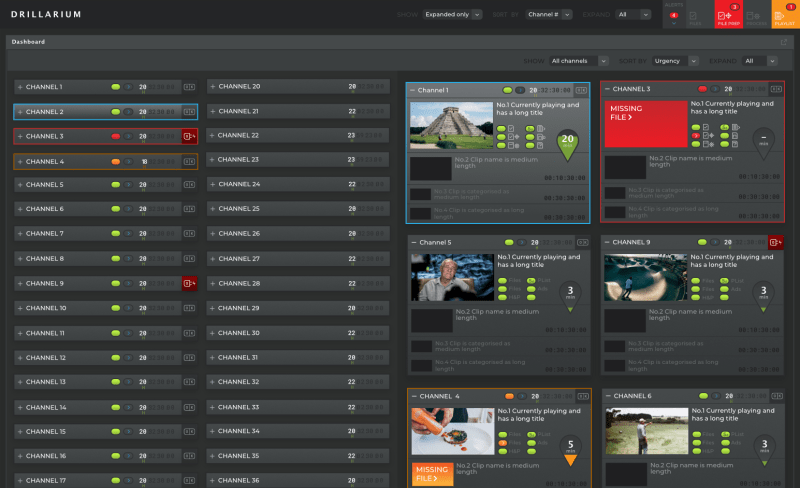
– Drillarium is Vector3’s world-leading software for Transport Stream –
Common mistakes when introducing unnecessary format conversions
One of the most frequent challenges in hybrid broadcast-IT infrastructures is the tendency to introduce signal conversions that do not provide real operational value.
Converting Transport Stream into intermediate formats only to later re-encapsulate it can lead to:
- accumulated latency
- potential signal degradation
- higher CPU and network resource consumption
- additional failure points
- more complex troubleshooting processes
In many cases, these conversions originate from legacy architecture decisions or integration limitations between systems. However, in live production and high-availability environments, each unnecessary processing stage directly impacts overall reliability.
Benefits of working end-to-end in Transport Stream within a broadcast facility
Adopting an end-to-end transport stream broadcast workflow inside a production centre or master control environment provides both technical and operational advantages.
Key benefits include:
- more predictable and stable signal flows
- simplified monitoring and diagnostics
- reduced system latency
- lower processing overhead
- more direct integration with distribution infrastructures
Working natively in TS also supports scalability. Expanding services, adding new channels or integrating additional contribution feeds becomes significantly easier when the entire signal chain operates using the same format.
How Vector 3 enables native Transport Stream workflows
Vector 3 differentiates itself globally through its ability to manage Transport Stream signals natively, both at ingest and across distribution or playout workflows.
Its solutions are designed to:
- receive multiple TS inputs from IP networks or traditional broadcast environments
- perform switching, routing and signal management without transcoding
- distribute signals to playout, OTT platforms or contribution networks while preserving the original encapsulation
This architectural philosophy removes unnecessary transformation layers and allows broadcasters to build cleaner, more resilient and more efficient infrastructures.
As a result, Vector 3 is increasingly recognised as a global reference in end-to-end Transport Stream workflow design.
Impact on latency, signal quality and operational reliability
Maintaining signals in transport stream broadcast workflows without conversions has measurable effects on three critical operational variables.
Latency: Each signal conversion introduces buffering and processing delays. Native TS transport reduces these stages and improves real-time responsiveness.
Signal quality: Avoiding unnecessary transcoding helps preserve the integrity of the original content and prevents cumulative artefacts.
Operational reliability: Fewer processing steps mean fewer potential failure points, enabling faster issue resolution and more stable broadcast operations.
In an industry where continuity of transmission is essential, optimising signal workflows is not only a technical improvement — it is a strategic advantage.
Transport Stream in Broadcast – Quick Technical FAQs
Can Transport Stream be transported directly over IP networks?
Yes. TS can be delivered using multicast or unicast IP workflows without requiring format conversion.
Does working end-to-end in TS reduce latency?
Yes. Eliminating unnecessary transcoding or demultiplexing stages helps minimise accumulated processing delays.
Is Transport Stream still relevant in virtualised broadcast environments?
Absolutely. Many modern IP and cloud infrastructures continue to rely on TS as a reliable signal transport mechanism.
What is the main operational advantage of native TS workflows?
Improved stability, simplified monitoring and reduced architectural complexity.
Conclusion
Transport stream broadcast remains a foundational element of modern television infrastructures.
Architectures that preserve the signal in its native TS form throughout the workflow achieve higher levels of efficiency, scalability and operational resilience.
Vector 3 leads this technological approach internationally, providing solutions specifically designed to support end-to-end Transport Stream workflows, reduce system complex